Articles
Reflections on design, ritual, and the art of intentional living.
Reflections on design, ritual, and the art of intentional living.
Published August 12, 2026
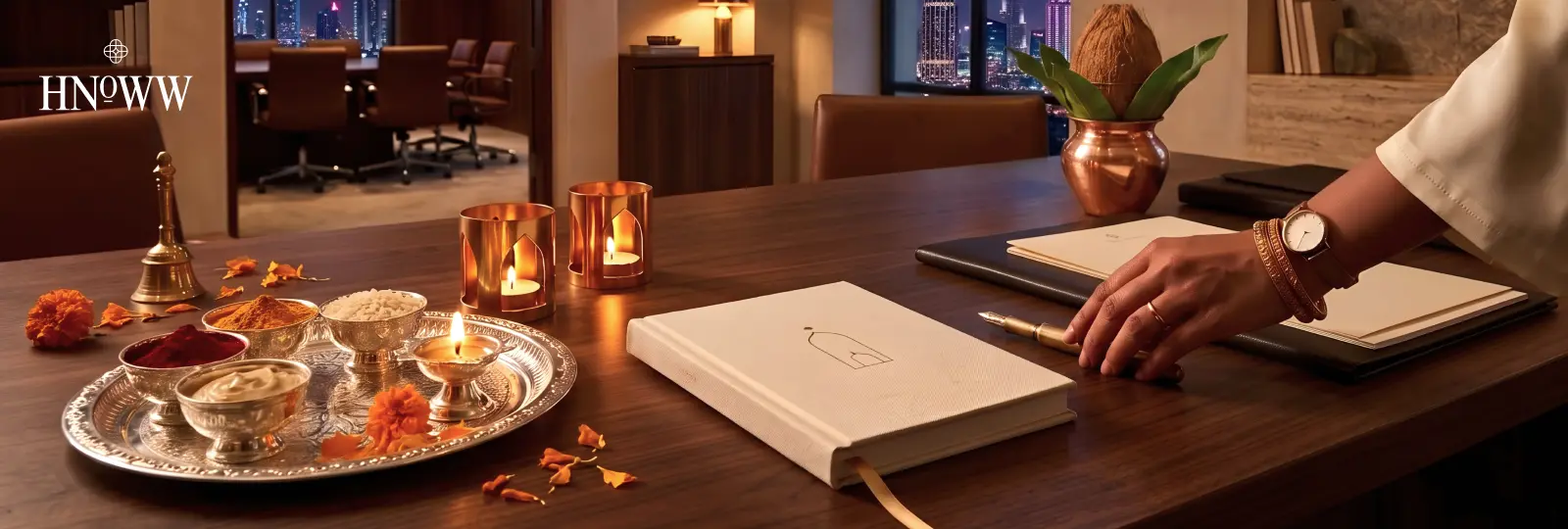
The Diwali night arrives, and the shop becomes silent in its own manner. The counters have been cleaned, marigolds placed at the entrance, and there is some incense fragrance coming from the back, where a red sheet has been kept for the puja in the evening. But before closing the shutters, the ledger is brought out again, and this time not for accounting.
The bahi khata spends most of its life doing ordinary work. Names, payments, credit given and taken. But on this one evening it gets handled a little differently. Kumkum goes on the cover. A diya is lit beside it, rice and flowers and a few coins arranged around its edges, and when the first page is finally turned to, the words Shubh Labh and the Swastik are written across what was, a moment earlier, still blank.
That's chopda pujan in practice. For generations of Gujarati and Marwari business families, it's marked something bigger than a new set of account pages. It's the pause between one year and the next, a chance to close what's done and hope for something good before starting again. The name says it plainly: bahi means book, khata means account. To really get at what is chopda pujan, though, it helps to start with the two words sitting inside the name itself: bahi and khata.
Bahi is simply the word for a book or register. Khata means an account. Together, a bahi khata is the ledger that generations of Indian traders and business families have used to track the financial life of a business, and pujan adds the third piece: worship.
So chopda puja is, at its core, the ceremonial worship of a new business ledger during Diwali, done in the hope of prosperity, wisdom, and a year that goes well. The ritual is associated with goddess Lakshmi, the deity of prosperity, and Ganesha, who invokes knowledge and good fortune, and this is why the Lakshmi puja for business usually accompanies the book’s blessing ritual.
There's something worth sitting with in that pairing. A business spends most of its year chasing figures, closing deals, keeping the numbers balanced. For one evening, the numbers get set aside. The book that holds them is placed in front of the divine instead, and the next chapter starts with a blessing rather than an invoice.
Open an old bahi khata, and you'll find more in it than numbers. Names of customers, what they owed, what they'd paid, what had been bought on credit, sure. But depending on the family and the business, these books often turned into something closer to a record of relationships than a record of money.
Whose credit could be trusted. Which customer had stayed loyal across decades. Whose payment was still outstanding, and which supplier had quietly helped out during a hard season. Even the handwriting on a page could tell you something about who was keeping the books, and when.
That's part of why bahi khata diwali traditions carry more weight than plain bookkeeping ever could. The ledger wasn't only recording what a business earned. It was recording, in its own way, how the business had actually lived through the year. Retiring an old one for a new copy never really felt like tossing out a used notebook. It felt more like closing a chapter that mattered.
For most Gujarati business families, the closure of their previous year comes at the time of Diwali, but the beginning of their new book starts on Bestu Varas, the Gujarati New Year that follows. That timing is what turns Diwali into a genuine business new year diwali moment rather than just a festive backdrop, marking the actual shift from one year of accounts into the next.
The first page never gets treated like an ordinary one. Before any real invoice or payment gets written down, an auspicious mark usually goes at the top, often the word Shri or the more familiar Shubh Labh or Swastik is drawn, meaning auspiciousness and prosperity. Only once that first ceremonial line is in place does the book go back to being an account book. The idea behind it is fairly simple: start well, and let everything follow that lead.
The customs may differ according to different families and regions, but the general pattern of Diwali Chopda Pujan always seems the same. The new Chopda Pujan is done in the puja room, among the idols or photographs of Goddess Lakshmi and Lord Ganesha, along with the application of kumkum, rice, flowers, and diya.
Prayers and aarti come next, and only after that does anyone actually open the ledger. A word like Shri or Shubh Labh goes down first, occasionally followed by a small Swastik entry, and with that the book has technically begun its new life.
Some households keep this elaborate; others keep it small and quick between customers. What tends to matter more than the scale is simply that everyone stops long enough to notice the beginning happening.
Today, a business can close its books in a few clicks. Nowadays, invoices are generated by computers, payments are transferred digitally, and accounts reside somewhere in the clouds rather than in the clothbound book on a shelf. However, chopda pujan has not disappeared from the picture altogether.
It was never only about the book itself. For a founder, it can be one of the rare moments in a working year set aside purely for looking back rather than pushing forward. For a family business, it often functions as a thread between generations, kept alive mostly because someone before you kept it alive too.
Part of why the physical book still matters is that it gives an abstract idea an actual shape. You can hold it, write in it, set it on a table, come back to it next year in a way a folder on a server never quite allows. In a business world that's become largely invisible and digital, that bit of physicality carries more weight than it might seem to on paper.
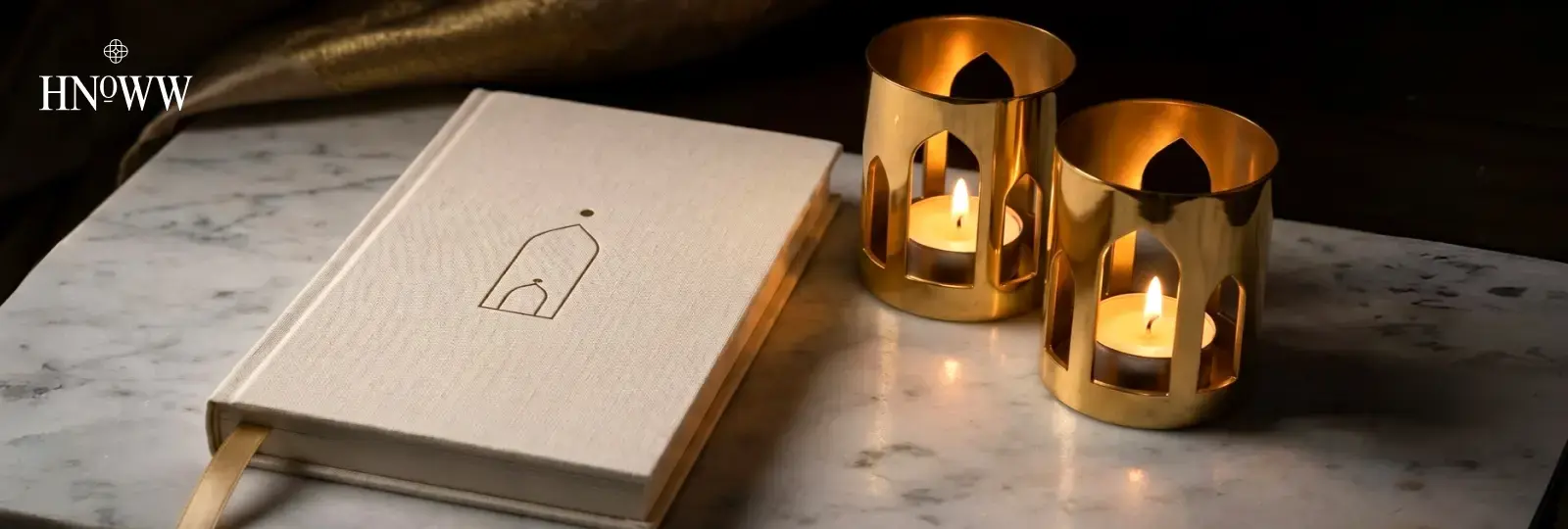
The idea that a bahi khata was always more than an account book is what makes Hnoww’s Aarambh fit naturally into the story. It takes the spirit of the traditional ledger and brings it into a contemporary setting, centred around the same idea of beginning again.
At its centre sits a linen-bound journal, its cover traced with a single gold arch, paired with two gold-finished tealight holders cast in the same silhouette. Lit at the threshold of the festival, the tealights mark a beginning of their own, while the journal gives that beginning a place to be written down.
For a founder, it can become a place to set down intentions for the year ahead. For a family business, it can find a natural place within the existing Diwali ritual. And given as a bahi khata gift, it means something a bit more than the usual festive gesture; it's really the idea of handing someone a place for whatever comes next. Together, the journal and tealights form a small ritual of their own: somewhere to write, pause, light a flame, and begin. Some beginnings are worth marking properly, and this is built for exactly that.

Chopda pujan begins with a book, and grows into something far bigger than one. It's about closing one year with gratitude and starting the next with a little hope for the business, but also for family, faith, and memory. Most of that hasn't changed, even as the books themselves have. A ledger today might live on a laptop instead of a shelf, but the instinct behind chopda pujan hasn't moved with it. Somewhere, someone still wants a moment that marks the year properly, rather than letting one simply fade into the next, whether that's a bahi khata brought out once a year or something like Aarambh, kept closer to hand all year round.
Maybe that's why a handwritten Shubh Labh and Swastik on a blank page still means something, even now. For one quiet moment, before the numbers start again, the page sits empty, the diya burns, and someone sits down to write those two words. That's really what chopda pujan comes down to: not just marking a new business year, but giving that beginning a moment of its own.
ARTFUL GIVING • GLOBAL INQUIRY